Pearl Abyss Responded to 2,000 Chinese Reviews and Flipped the Score by Half!
Two weeks ago Crimson Desert launched to 44,833 reviews and a 67% positive score. The Chinese market was the cause of the lower reception: 42% positive from nearly 7,000 reviews with players calling out boss design, lack of onboarding, and quest logic in ways that went beyond the universal complaints about controls and UI. The developer replied to zero forum threads. Then the AI art scandal broke mid-week.
It looked like a rough start to a long recovery, though the data two weeks later tells a different story.
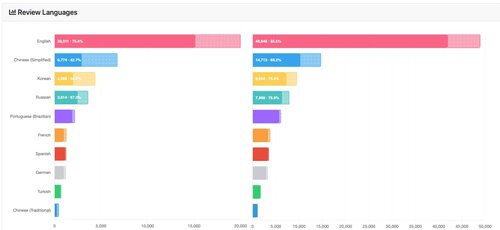
As of now Crimson Desert has a total of 107,766 reviews, and is sitting 82.5% positive overall. Chinese sentiment up from 42.6% to 69.2%. Korean from 44.7% to 75.4%. English from 75.4% to 85.8%.
4,609 reviews flipped from negative to positive. The game that launched into "Mixed" territory is now tracking toward a full recovery across every major market.
While developers didn't head into the Steam forums to start making the recovery - they respond directly to 2,622 individual Steam reviews: 2,060 of them in Chinese, and the rest in English or Korean. Of the 4,609 reviews that flipped negative to positive, 994 Chinese flips came after a direct developer response. The ratio is striking: they responded to Chinese reviews at roughly fourteen times the rate of English ones, in a market that was their biggest problem, and it moved the needle measurably.
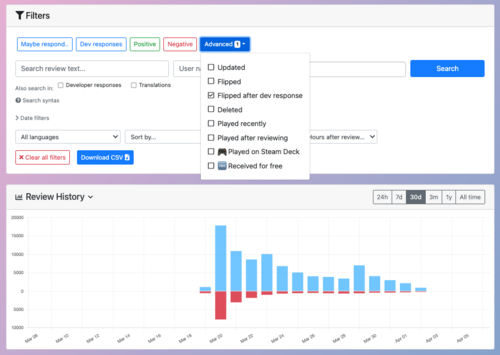
The "Flipped after dev response" filter in Gameplainer makes this visible in a way that raw review scores can't. Filtering by language, then by flipped reviews, then by dev response, you can see exactly where the recovery happened and what drove it. 994 Chinese reviews flipping positive after a direct response isn't a coincidence. It's a strategy.
My forum thesis ("Showing up in your community == better review sentiment") holds up across most of the data I track, but Crimson complicates it in a useful way. Forums are one channel, direct responses to reviews are another. Pearl Abyss chose the later (at a pretty intense scale) in the language that mattered most - while patching the game almost daily in the background.
The recovery data suggests Pearl Abyss understood something about where their audience actually was, and went there directly.
Stay in the loop
Get notified when we publish new articles on game development and player feedback.
