RACCOIN Proves What Happens When You Treat Launch as the Finish Line


RACCOIN launched with eight forum sections, demo feedback boards going back eight months, and a developer who is the most active poster in their own community. This week's data shows exactly what that kind of preparation looks like at launch.
Data from March 28 - April 04, 2026
The story running through this week's data is all about preparation.
RACCOIN: Coin Pusher Roguelike launched with one of the more interesting Steam Forums I've seen - eight dedicated Steam forum sections, feedback boards for demos going back to August 2025, and a developer who is the most active poster in their own community by a wide margin. Nearly 90% of forum users who reviewed went positive. That's not a coincidence but the result of months of groundwork.
The pattern holds with Cinderia and their three developers in its top five forum posters and a 35% thread response rate. Chinese players are specifically citing the update cadence in positive reviews. On the flip side though this weeks most reviewed game Weeping Swan has 2,399 reviews and just two replies from the team.
Let's dive in!
Top Performing Games

The Weeping Swan: Ten Days of the City's Fall is almost entirely a Chinese-market game. 96.6% of reviews are in Chinese Simplified, with the remaining split between Traditional Chinese, Japanese, and a handful of other languages. The 76% positive score is the story of one audience, not a global one.
The sentiment (specifically: Chinese sentiment) split neatly. Players who loved the game praised the music, atmosphere, and emotional depth. Players who don't find the narrative self-indulgent and the endings punishing. The two most upvoted reviews in the entire game are both negative , both scathing, and both have over 1,300 votes each. The third most upvoted is a seven-character poem that functions as a historical joke. This is a game that provokes strong reactions and the audience is engaged enough to vote on them.
The forum data is thin relative to the review volume. 141 threads, 201 unique posters, 2 team replies. For a game that generated 2,399 reviews in three days, that's a low engagement ratio. The developer presence is minimal, and the forum-to-review conversion at 58.1% positive reflects a community that's divided rather than rallied.
The complaints about tragic endings and lack of resolution cut across the positive and negative reviews alike. Even players who recommend the game often do so while grieving the outcomes. For a narrative game, that's a specific kind of feedback worth sitting with.

RACCOIN: Coin Pusher Roguelike sits at 86% positive from 1,946 reviews, with English speakers making up 57% of the review base and landing at 88%. Chinese players are slightly cooler at 81% but broadly positive. All up a pretty healthy launch across the main markets.
A coin pusher arcade machine crossed with roguelike deck-building is an unlikely combination, and the reviews reflect genuine surprise at how well it comes together - I chuckled when I saw that dopamine was mentioned in 3.5% of all reviews 😅.
The negative reviews are almost entirely structural: too much RNG, an overwhelming tutorial, crashes at high scores (though at least one user actually called out their crash as a net positive!)
The forum setup is the most interesting thing about RACCOIN this week. Eight separate forum sections, including dedicated feedback boards for a November 2025 demo, a February 2026 NextFest demo, and an August playtest. Playstack's own smithbodie has 114 posts, the highest individual count of any developer tracked in this week's data. 88.9% of forum users who reviewed went positive. This isn't a studio that discovered community management at launch. Publisher Playstack has been building infrastructure for months, and it shows.

Subliminal is a backrooms-inspired psychological horror game sitting at 67% positive from 1,737 reviews. That's a fragile score for a game with genuine strengths: the atmosphere and visuals are consistently praised across every language, and the nearly 5% of all reviews have labeled the game a "horroesque" Stanley Parable.
The problems though are specific and consistent. Chase sequences are described as trial-and-error rather than skill-based. Puzzles are opaque enough that players describe them as frustrating rather than rewarding. The checkpoint system is described several times as failing at exactly the moments it matters most - mid-chase, where dying sends players back too far.
The language split is worth noting. Chinese players land at 78% positive, Russian at 63%, English at 66%. Korean is the outlier at 30%, though the sample size is small enough to treat with caution. The Chinese sentiment specifically calls out the atmosphere and puzzle mechanics positively, suggesting the core experience lands better with an audience that has patience for obtuse design.
On the Steam forums the developer has made 12 replies across 303 threads. Forum-to-review conversion sits at 66.3% positive, almost exactly mirroring the overall score. For a game this close to the line between Mixed and Mostly Positive, that's a missed opportunity.

Hozy
Hozy sits at 83.7% positive from 1,511 reviews. It's a cozy room-cleaning and decorating game, and the audience it found is largely the right one. Sentiment is consistent across languages, with English at 86%, Russian at 86.5%, and French at 86.4%. Chinese and German are slightly cooler at 78%, but nothing dramatic.
The two most upvoted reviews are both negative 1 2 , and both are specifically about the same thing: 9 levels isn't enough. Players aren't complaining that the game is bad. They're complaining that it ended. That's less a content problem than an expectation problem - players weren't prepared for where the game would stop, and the store page may not be setting that up clearly enough.
The forum data is strong. 18.8% team response rate, with Bug Reports hitting 51.5%. The developer is clearly prioritising the right section: players filing bug reports are the most motivated to flip a negative review if they're heard. Forum-to-review conversion sits at 75% positive from a small but meaningful sample.
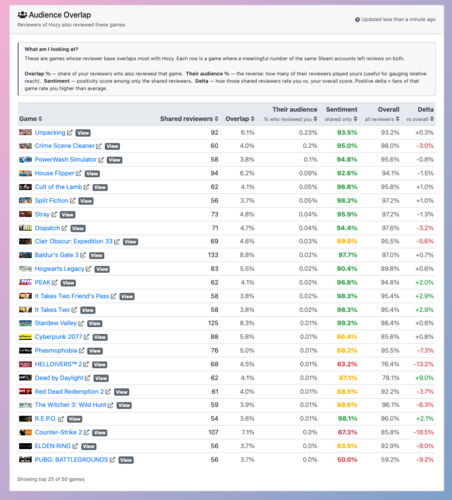
The audience overlap data tells you exactly who bought Hozy. Unpacking, House Flipper, PowerWash Simulator, Crime Scene Cleaner: the cozy tactile game canon. Baldur's Gate 3 has the most shared reviewers at 133, which is the outlier, though BG3's sheer size makes it appear in almost every overlap table. The delta column is the useful signal: shared reviewers from It Takes Two and PEAK rate Hozy above average. Shared reviewers from Counter-Strike 2 and Helldivers 2 rate it well below. The game is landing with its people and taking heat from everyone else.

Cinderia
Cinderia is an early access roguelike sitting at 86% positive from 1,255 reviews. The regional split tells a familiar story: English at 96.4%, Russian and Korean both at 100%, while Chinese sits at 81.9%.
The art style, combat feel, and build variety land consistently across markets. The Chinese feedback gets more specific about where the game breaks down: character balance is the biggest complaint, with certain classes so far ahead of others that the gap is hard to ignore. English players are broadly enthusiastic in ways that suggest they haven't reached the same point in the game yet.
Three developers appear in the top five forum posters. The team response rate is 34.7%, with 35% of General Discussion threads and 30.8% of Events and Announcements receiving replies. Forum-to-review conversion sits at 80.9% positive which is pretty great!
Multiple Chinese reviewers 1 2 independently use the same classical idiom to describe the developer's update pace - Gameplainer's translation tools flag it as 'heaven rewards the diligent.'
That kind of unprompted goodwill is rare in review data, and it's showing up in the numbers.
Stay in the loop
Get notified when we publish new articles on game development and player feedback.
